

A settled choice the team has committed to.
// Swahili · “remember!”
The governed, auditable source of truth your assistants actually follow.
kumbuka is the open-source governance layer for your AI assistants’ knowledge: the decisions, conventions, and constraints your team has ratified — typed, auditable, curated by humans instead of auto-extracted. Served to Claude and any MCP-capable client over a single endpoint.
endpoint https://mcp.kumbuka.ai/mcp
› memory_recall(scope:"project/payments", q:"money")
← constraint money is integer minor units, never floats
decision Postgres is the system of record
convention service names are kebab-case
// The problem
Every session starts from zero.
AI assistants are stateless between conversations. So teams re-explain the same context forever — and when it comes back inconsistently, the work drifts.
Re-explained
“We use Postgres as the system of record.”
Re-explained
“Money is integer minor units, never floats.”
Re-explained
“Service names are kebab-case.”
// How it works
Read at the start. Written back through one endpoint.
kumbuka serves work-steering knowledge — rules and decisions, not a copy of your docs or source. The assistant reads it; the team curates it.
Step 01
memory_load_context
Recall
At session start, the assistant loads your team’s steering knowledge for the scopes it’s working in.
Step 02
memory_recall
Apply
It works against your decisions and constraints as it goes — no one has to re-explain them.
Step 03
memory_remember
Curate
New decisions are written back, then reviewed and refined by the team in the admin console.
↻ One loop, one endpoint — memory_remembermemory_recallmemory_forgetmemory_scopesmemory_load_context
// See it work
One member decides. The whole team remembers.
Watch how a decision made in one chat reaches a teammate in another — without anyone re-explaining a thing.
LV
LenaArchitect
// Team memory0
Shared, typed, team-owned.
TF
Tomnew engineer
// The taxonomy
Six kinds of knowledge.
Every entry is typed, so the assistant and the team always know what they’re looking at.
decision
convention
A shared default way of doing things.
constraint
A hard boundary that must not be crossed.
open_question
Unresolved — needs an owner and an answer.
glossary
A term defined so everyone means the same thing.
status
The current state of something in motion.
// Scopes
Three scopes. One boundary that holds.
Memory is organised into scopes, so the right knowledge reaches the right people — and nothing else does.
Private
Yours alone
A per-user space, owned by you and reachable only by you. Your working notes never leak into the team’s view.
Owner-only
Project
Team-shared
Shared spaces a team curates together — the decisions and conventions for a service, product, or area of work. Perfect for Projects in Claude and ChatGPT.
Team-shared
Global
Org baseline
One org-wide baseline everyone inherits — the conventions and constraints that hold across every project.
One, org-wide
// The private guarantee
Private means private. Enforced, not configured.
Data-access layer
No admin read
No team API
A member’s private scope is owned by them and reachable only by them — only through the MCP surface, under their own session.
No admin, no console screen, and no team-facing API can read it.
It’s enforced at the data-access layer — not by a configuration toggle that could be flipped. Disabling a user leaves their private memory untouched and theirs.
// For developers
Self-hosted. Open source. One Compose stack.
A single Docker Compose stack you run yourself. No accounts to create, no data leaving your control.
Transport
MCP over Streamable HTTP
Auth
OAuth 2.1 via Keycloak
Backend
Quarkus + PostgreSQL
Console
Next.js admin console
Deploy
Single Docker Compose
License
AGPL-3.0
Endpoint
Read the docs →
https://mcp.kumbuka.ai/mcp
Works with claude.ai and any MCP-capable client.
// The console
Curate it together.
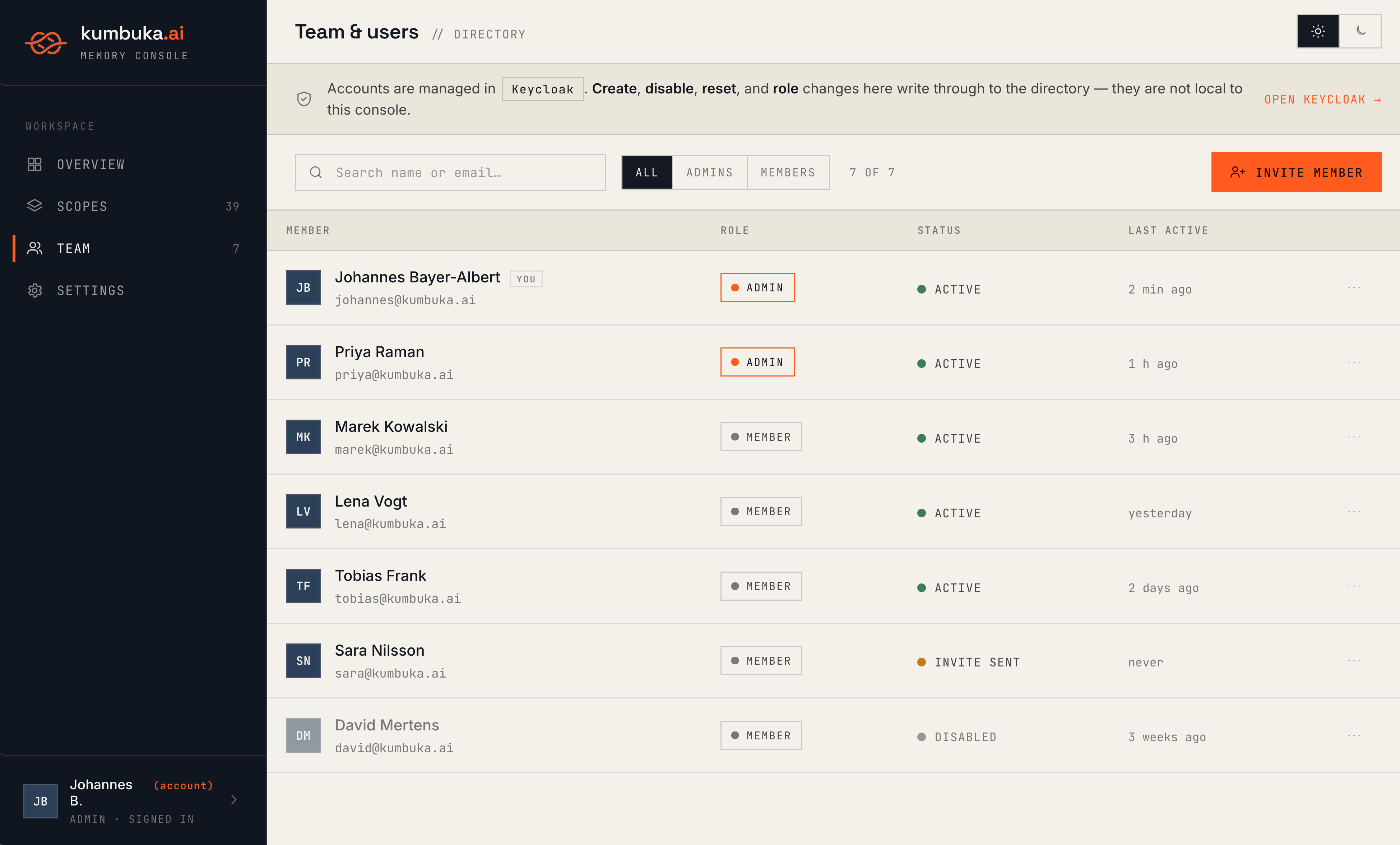
The admin console is where the team reviews, edits, and organises shared memory — the human side of the same endpoint the assistant reads.
// Closed beta
For teams that keep control of their decisions.
The closed beta is intentionally small — we review every request individually. Join if you care about governance, durability, and team ownership.
- We’re in beta — and listening.
- Shape the roadmap with us.
- A partnership, not a sign-up — come build with us.
// Closed beta
Give your assistants a memory your team owns.
Request access to the hosted closed beta — or self-host the open-source Community Edition and own the whole stack.